AI Resilience Planning

If your entire operation depends on a single AI provider, you are one status-page incident away from a full stop. At tabiji, our pipelines run all day generating itineraries, destination guides, and structured venue data. When an upstream API goes dark, we can't pause production and wait it out.
So we benchmarked our fallback model head-to-head against our primary driver on identical production tasks — and discovered our "backup" was faster, equally accurate on structured output, and 62× cheaper.
In a head-to-head benchmark on 5 production travel guides, MiniMax M2.7 matched Claude Opus 4.6 on structural accuracy (100/100), ran 25% faster (416s vs. 559s), and cost 62× less ($0.004/page vs. $0.27/page).
- 99.04% API uptime means ~20.7 hours of downtime per quarter — relying on a single frontier provider guarantees multi-hour pipeline stalls every few weeks.
- Fallbacks can beat primaries on structured work — at 1,000 pages, MiniMax M2.7 costs $4.00 vs. $270.00 on Claude Opus 4.6 with zero loss in schema compliance or venue verification.
- Run a 3-tier routing stack — separate your primary reasoning model (Claude Opus 4.6), cross-provider fallback (Gemini 2.5 Pro), and high-volume workhorse (MiniMax M2.7) behind circuit breakers.
The Problem: Single-Provider Dependency
Look at the 90-day uptime numbers from Anthropic's public status page:
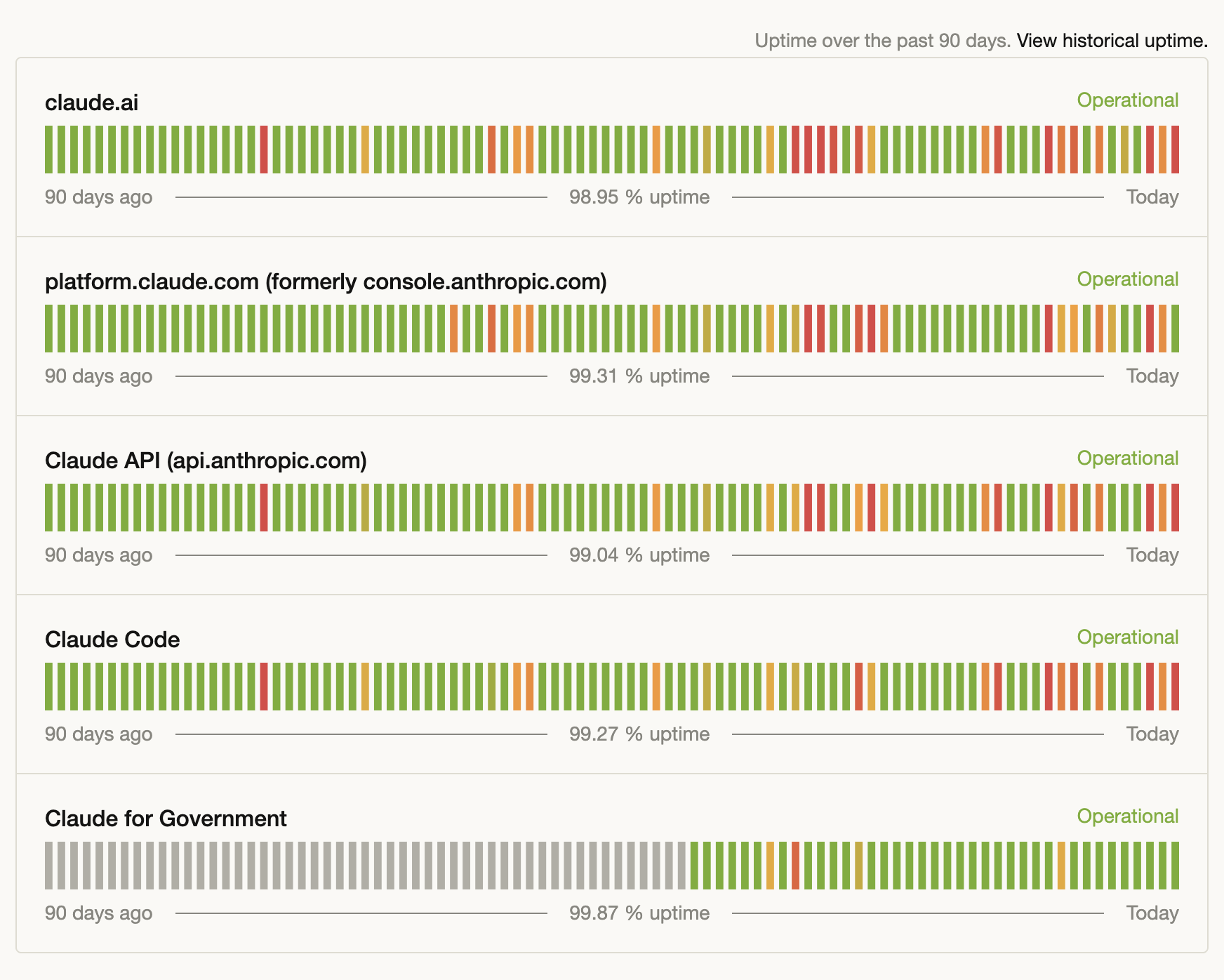
Anthropic's own status page, March 2026. 90-day uptime across all services.
Translated across a 90-day (2,160-hour) window, "two nines" of availability adds up fast:
| Service | Uptime | Downtime (90 days) | Annualized |
|---|---|---|---|
| claude.ai | 98.95% | ~22.7 hours | ~3.8 days/year |
| Claude API | 99.04% | ~20.7 hours | ~3.5 days/year |
| Claude Code | 99.27% | ~15.8 hours | ~2.7 days/year |
| platform.claude.com | 99.31% | ~14.9 hours | ~2.5 days/year |
| Claude for Government | 99.87% | ~2.8 hours | ~0.5 days/year |
The commercial Claude API was degraded or down for 14 to 20+ hours in a single quarter. Those aren't sub-second network blips; they're multi-hour outages that wedge cron queues and stall customer-facing pipelines. And it's not an Anthropic-specific flaw — OpenAI and Google Vertex hit similar turbulence under load.
99% uptime sounds enterprise-grade until you do the math. It's 3.6 days of downtime per year. For an AI-dependent production workflow, that's not an edge case — it's a scheduling constraint.
Our Benchmark: MiniMax M2.7 vs Claude Opus 4.6
To test whether a secondary provider could carry production load during an Anthropic outage, we ran an identical batch on both models: generate 5 "popular picks" destination guides with verified venue names, rich descriptions, JSON metadata, and strict HTML template compliance.
Speed: MiniMax was 25% faster
MiniMax finished the 5-page batch in 416 seconds versus 559 seconds on Claude Opus — shaving nearly two and a half minutes off every 5-page run.
Quality: Tied at 100/100
Both models scored 100/100 on structural accuracy and matched across our manual spot-checks:
- Real venue names: Zero fabricated restaurants or fictional attractions in either batch.
- Description depth: Both wrote specific, natural-sounding venue blurbs without repetitive boilerplate.
- Template compliance: Both adhered to the exact HTML hierarchy, schema blocks, and internal link structure.
Cost: 62× cheaper
| Metric | MiniMax M2.7 | Claude Opus 4.6 | Difference |
|---|---|---|---|
| Cost per page | $0.004 | $0.27 | 62× cheaper |
| Time for 5 pages | 416 seconds | 559 seconds | 25% faster |
| Structural accuracy | 100/100 | 100/100 | Tied |
| Real venue names | ✅ All verified | ✅ All verified | Tied |
| Description quality | Comparable | Comparable | Tied |
| Cost for 100 pages | $0.40 | $27.00 | $26.60 saved |
| Cost for 1,000 pages | $4.00 | $270.00 | $266.00 saved |
For structured generation with explicit schemas, paying $270 per 1,000 pages when a $4 model hits the exact same quality bar makes no sense — which is why our "fallback" became our default content workhorse.
The fallback model wasn't a compromise. It was faster, equally accurate, and cost almost nothing. The only reason Claude Opus remains our primary is its edge on complex reasoning tasks — not content generation.
Building a Resilient AI Stack
A production-grade agent stack separates models into three explicit tiers across distinct cloud providers:
Tier 1 — Primary
Your best model for complex, nuanced tasks. Worth the premium for reasoning, analysis, and critical decisions.
Tier 2 — Fallback
Comparable quality from a different provider. Activates when Tier 1 is down or rate-limited. Must be from a separate infrastructure.
Tier 3 — Budget
For cost-sensitive, high-volume tasks where "good enough" quality meets the bar. Runs the bulk of your routine workload.
How to benchmark candidate fallbacks
- Test on a real production job, not a toy prompt. Pull 5–10 representative items from your actual queue.
- Keep prompts identical. Run the exact same system prompt, input payload, and JSON schema across both models.
- Grade with deterministic checks first. Score schema validity, entity accuracy, wall-clock latency, and actual dollar cost before judging prose style.
- Re-run monthly. Model checkpoints drift and pricing changes; a monthly automated eval catches regressions before an outage forces a blind switch.
Routing and failover patterns
- Hard request timeouts + automatic failover: Cap generation calls at 30–60s; on a timeout or
5xx, retry once and immediately fail over to Tier 2. - Circuit breakers: After 3 consecutive failures from an upstream API, trip the circuit breaker and route traffic to the fallback for 5 minutes instead of piling onto a dead endpoint.
- Provider-agnostic prompts: Keep core prompt templates portable and isolate vendor-specific quirks (like tool-call formatting or cache headers) in a thin adapter layer.
What We Actually Run
Here is how we split workloads across providers at tabiji as of March 2026:
| Role | Model | Provider | Why |
|---|---|---|---|
| Complex reasoning | Claude Opus 4.6 | Anthropic | Best-in-class for nuanced analysis, code generation, multi-step reasoning |
| Content generation | MiniMax M2.7 | MiniMax | Fast, cheap, quality parity for structured content. Our primary content workhorse |
| Image generation | Gemini (Nano Banana 2) | Best prompt adherence, cheapest per image, highest resolution | |
| Fallback (reasoning) | Gemini 2.5 Pro | Strong reasoning capabilities, different infrastructure from Anthropic |
When Claude went down for four hours last month, our content queues didn't drop a single job — MiniMax carried the batch load while Gemini 2.5 Pro covered reasoning tasks. Resilience isn't an emergency patch you write during an outage; it's routing architecture you wire up while everything is green.
Benchmark data collected March 2026. Uptime data from status.anthropic.com (90-day window as of March 27, 2026). All benchmark runs used identical prompts and scoring criteria.
Newsletter
Get the next post by email.
One email when I publish something new. No spam, no fixed schedule, unsubscribe anytime.