The Day Claude Banned OpenClaw

Saturday morning started like any other. Our cron jobs were firing, Instagram Reels were publishing, and our travel content pipeline was humming along on Claude Opus 4.6 — our daily driver for the past six months. Then, without warning, every job started throwing connection refused.
Anthropic had cut off OpenClaw subscription routing across its API ecosystem. Within minutes, the community Discord was in freefall as builders who had wired their entire agent fleets around Claude stared at dead pipelines. That kicked off a 48-hour sprint to benchmark every viable replacement model on the market — and led us to a hybrid stack that runs faster and cheaper than what we had before.
When Anthropic blocked OpenClaw routing, we benchmarked five replacement models across our production crons and landed on a split architecture — GLM 5.1 inside OpenClaw plus Claude Code in the terminal — that cut costs and improved reliability.
- GLM 5.1 won the OpenClaw benchmark — matched Claude's quality on scheduled research and content crons at ~1/10th the token cost of GPT-5.4, beating MiniMax M2.7, MIMO, and Qwen 3.6.
- Claude Code CLI replaces chat-loop coding — running
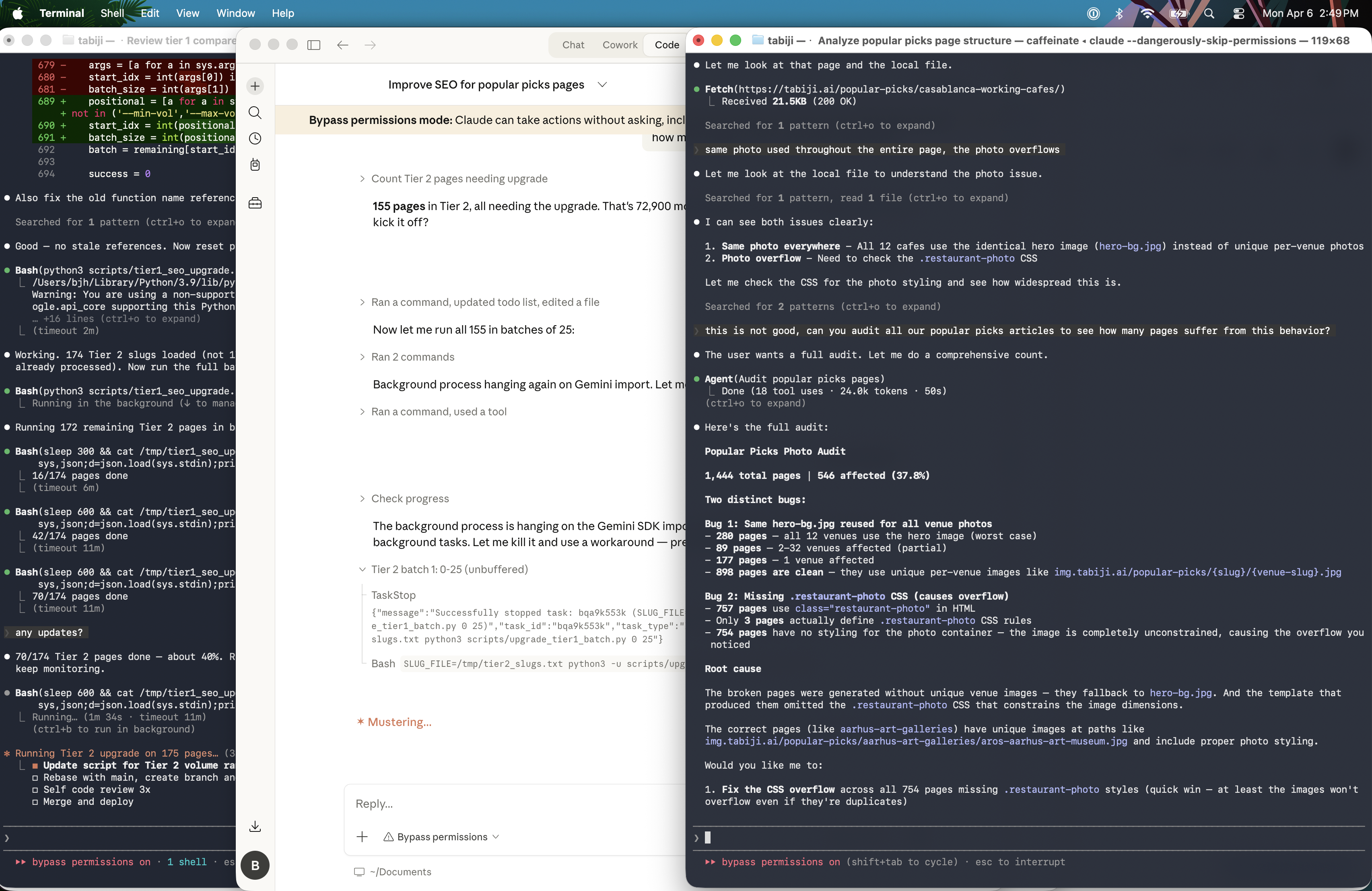
claude --dangerously-skip-permissionsin an isolated terminal audited 1,444 pages in 50 seconds (24.0k tokens, 18 tool calls) with zero modal popups. - Decouple orchestration from model lock-in — separating your scheduler (OpenClaw), workhorse model (GLM 5.1), and repo tool (Claude Code) eliminates single-vendor kill switches.
The Models We Tested
We ran identical production workloads across five candidate models: Reddit thread synthesis, travel itinerary generation, Instagram caption drafting, cron scheduling logic, and video script production. Every model was graded on output quality, latency, and token cost.
| Model | Quality | Speed | Token Cost | Verdict |
|---|---|---|---|---|
| GPT 5.4 (OpenAI) | Excellent | Fast | High | Capable, but expensive at cron volume with no decisive quality edge. |
| MiniMax Highspeed M2.7 | Good | Very Fast | Very Low | Strong on structured JSON tasks; flatter on nuanced research synthesis. |
| MiniMax MIMO | Decent | Fast | Low | Fine for mechanical transformations, not a full Opus replacement. |
| Qwen 3.6 | Good | Moderate | Low | Solid reasoning, but verbose and prone to creative drift. |
| GLM 5.1 (Zhipu AI) | Excellent | Fast | Very Low | Best all-around replacement. Sharp, fast, cheap — our new OpenClaw default. |
Bottom Line
GLM 5.1 won on every axis that matters — delivering Claude-tier instruction following at a fraction of GPT-5.4's token price, without the creative hallucinations we saw from Qwen 3.6.
But Then We Tried Claude Code
While benchmarking OpenClaw replacements, we still wanted Claude Opus for the two workloads where it genuinely leads: repository-scale coding and long-form editorial drafting. Instead of routing those tasks through a third-party harness, we moved them directly into Claude Code, Anthropic's native terminal CLI.
Claude Code Feels Like a Tool, Not an Agent
Running Claude in a chat window feels like talking to an eager colleague who narrates every thought. Running Claude Code in the terminal feels like invoking a Unix utility: it reads the repo, writes the patch, runs the test suite, and commits without theatrical commentary. Demos reward chatty agents; production pipelines reward quiet tools.
The Terminal Flag That Actually Matters
Out of the box, one friction point ruins automated runs: permission modals. That's where --dangerously-skip-permissions comes in.
The Desktop App Problem
The Claude desktop app interrupts constantly even with permission bypass toggled on. Every file write, shell command, and directory read triggers a confirmation prompt. Ten minutes in, you've spent more time clicking "Allow" than shipping code — making it a non-starter for unattended runs.
Invoking Claude Code from the CLI with --dangerously-skip-permissions removes the human bottleneck entirely:
claude --dangerously-skip-permissions \
  --prompt "Fix the bug in fulfill-order.js where the email template path is wrong"
⚠️ Security Note
--dangerously-skip-permissions lets Claude Code execute arbitrary shell commands and modify files without confirmation. Only run it inside isolated containers, CI runners, or dedicated local workspaces where you control the blast radius.
The Hybrid Stack We Landed On
Instead of forcing one provider to do everything, we split our workloads by execution environment:
- OpenClaw + GLM 5.1 — All 24/7 cron jobs, Instagram Reel generation, Pinterest scheduling, social publishing, and data enrichment pipelines at ~1/10th the cost of GPT-5.4.
- Claude Code CLI (
--dangerously-skip-permissions) — Codebase refactors, script authoring, repo-wide audits (like the 1,444-page tabiji scan above), and deep editorial drafting.
The Unexpected Result
The forced migration improved both our unit economics and our uptime. GLM 5.1 runs our scheduled OpenClaw loops faster and cheaper than Claude did, while native Claude Code in the terminal is more deterministic for repo work than routing Claude through a third-party agent harness.
What the OpenClaw Ban Taught Us
When your orchestration layer, your coding workflow, and your cron jobs all depend on a single model provider's terms of service, you are one policy update away from a Saturday morning outage. Resilient agent architecture separates three concerns:
- A model-agnostic scheduler (OpenClaw) that can swap upstream LLM endpoints in one config file.
- A high-throughput, low-cost default model (GLM 5.1) for 90% of recurring background tasks.
- A direct, first-party CLI (Claude Code) for heavy repository and reasoning work outside the cron loop.
Getting cut off on a Saturday morning was painful, but it forced an architecture review we had been putting off for months — and left us with three independent failure modes instead of one single point of failure.
Newsletter
Get the next post by email.
One email when I publish something new. No spam, no fixed schedule, unsubscribe anytime.